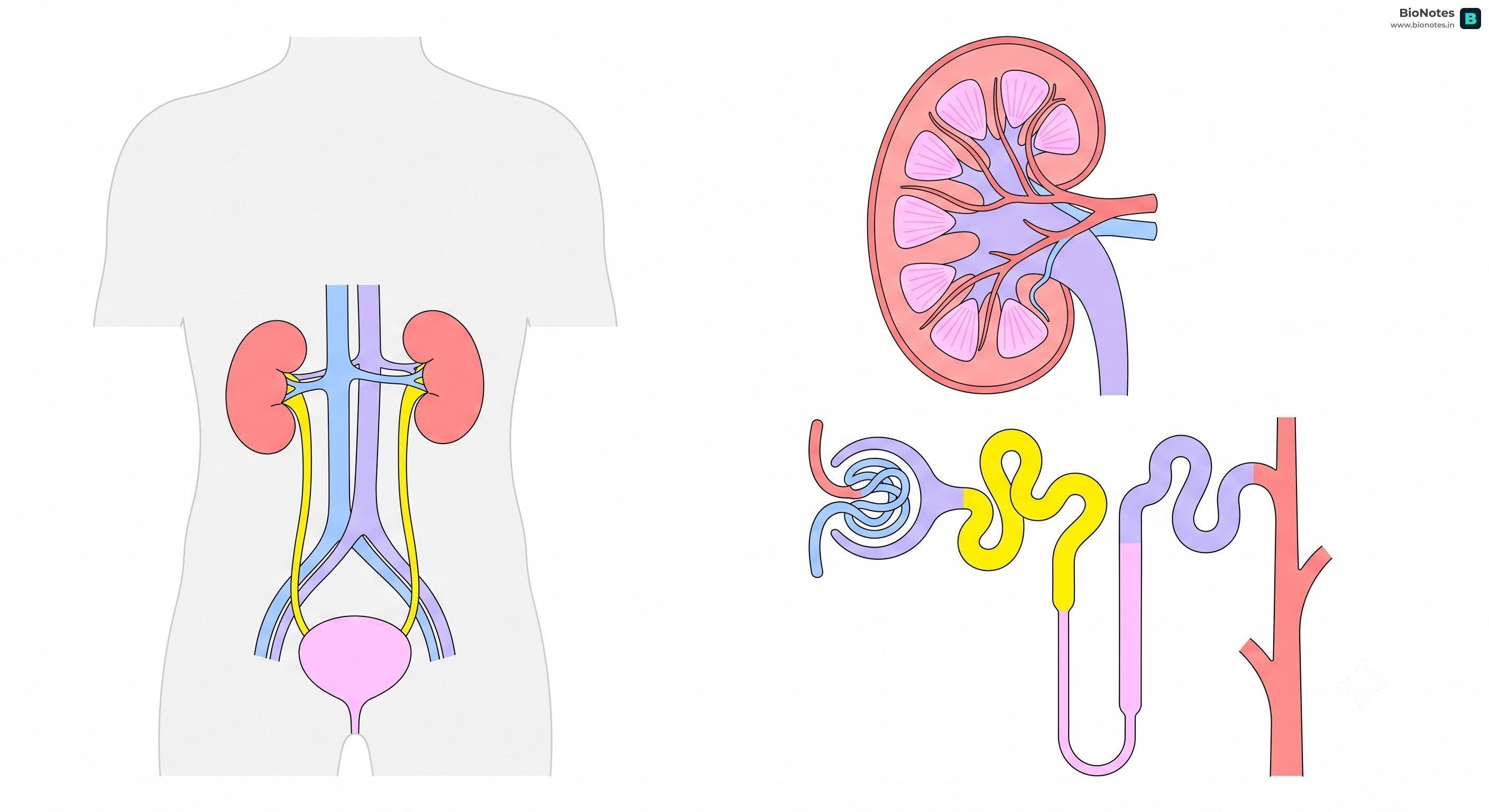
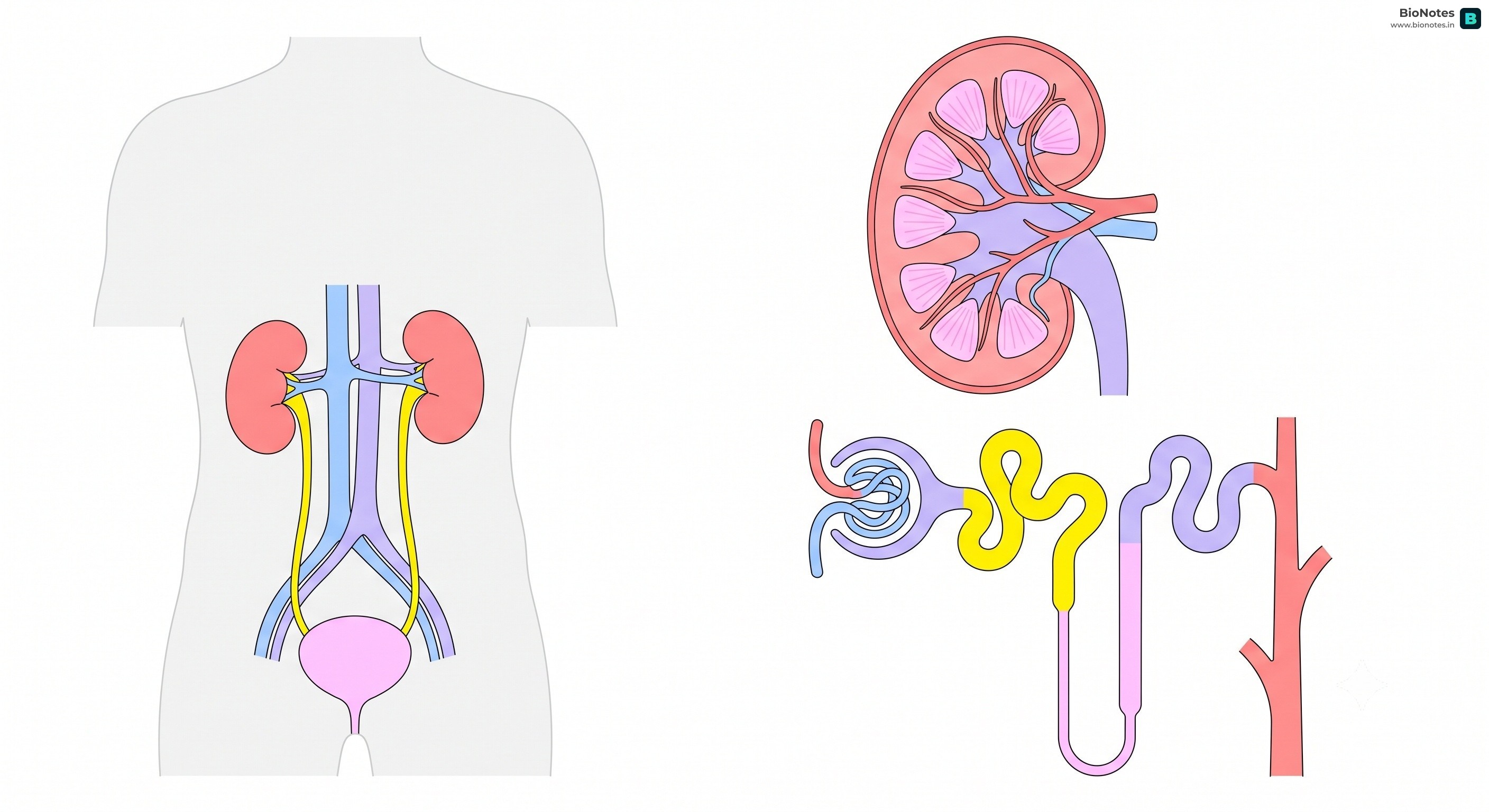
The human excretory system is a vital biological system responsible for removing waste products from the body to maintain homeostasis, the body's stable internal environment. This process, called excretion, involves filtering waste materials from the blood and expelling them as urine.
Watch Out! Excretion is a very specific biological process. Don't fall for these traps:
Misconception 1:Feces (poop) is part of the excretory system.Correction: Feces is mostly undigested food and is expelled via egestion (Digestive System). Excretion strictly deals with metabolic waste produced by cells (like urea in urine).
Misconception 2:The bladder filters the blood.Correction: The kidneys filter the blood. The bladder is merely a muscular storage sac for the urine produced by the kidneys.
While the kidneys are the primary organs of the excretory system, several other organs play a crucial role in eliminating waste products:
The Lungs: The lungs are the primary organs of the respiratory system, but they also play a role in excretion by removing carbon dioxide, a waste product of cellular respiration, from the body when we exhale.
The Skin: The skin helps in excretion through the production of sweat, which contains water, salts, and a small amount of urea. Sweating helps in thermoregulation and the removal of some waste products.
The Liver: The liver is a vital organ with numerous functions, including the detoxification of harmful substances and the conversion of ammonia, a highly toxic waste product of proteinmetabolism, into urea, which is less toxic and can be safely transported to the kidneys for excretion.
Each kidney is a reddish-brown, bean-shaped organ. A tough, fibrous capsule, the renal capsule, encloses each kidney. On the concave side of each kidney is a depression called the hilum, where the renal artery, renal vein, and ureter attach.
The nephron is the microscopic structural and functional unit of the kidney. Each kidney contains about a million nephrons. Each nephron is responsible for the three-step process of urine formation: ultrafiltration, selective reabsorption, and tubular secretion.
A nephron consists of two main parts:
The Renal Corpuscle (Malpighian Capsule): This is the initial filtering component of the nephron. It consists of:
The Glomerulus: A tangled cluster of tiny blood capillaries.
The Bowman's Capsule: A double-walled, cup-like structure that surrounds the glomerulus and collects the filtrate.
The Renal Tubule: A long, convoluted tube that extends from the Bowman's capsule. It is divided into:
This is the first step in urine formation, which occurs in the Malpighian capsule. The high pressure in the glomerulus forces water, small solutes (like glucose, amino acids, salts, and urea), and waste products from the blood into the Bowman's capsule. Larger molecules like proteins and blood cells are too large to pass through the filtration membrane and remain in the blood. The filtered fluid is called the glomerular filtrate.
As the glomerular filtrate passes through the renal tubule, the body reclaims essential substances. Most of the water, glucose, amino acids, and essential ions are reabsorbed back into the blood in the surrounding capillaries.
The Renal Threshold
There is a limit to how much glucose the kidneys can reabsorb. If blood sugar is very high (as in Diabetes Mellitus), the excess glucose stays in the tubule and is excreted in the urine.
This is a highly selective process, ensuring that valuable substances are not lost in the urine.
In this final step, waste products and excess ions that were not filtered in the glomerulus are actively transported from the blood into the renal tubule. This includes substances like hydrogen ions, potassium ions, and certain drugs. This process helps to further cleanse the blood and regulate its pH.
The fluid that remains after these three processes is urine. It flows into the collecting ducts, passes through the renal pelvis, and enters the ureters to be transported to the bladder for storage and eventual elimination.
Syllabus History & Status (Constituents of Urine - ICSE 2028 onwards):
From ICSE 2028 onwards: Mandatory (Specifically added: "Normal constituents of urine" and "Abnormal constituents of urine with reference to blood, glucose, protein, bile").
Up to ICSE 2027: Optional / Reference Only (Not explicitly detailed in the syllabus).
Under normal physiological conditions, urine is a light-yellow liquid with a specific chemical composition. However, metabolic abnormalities or organ malfunction can lead to the excretion of abnormal substances:
The presence of certain substances in urine indicates underlying medical conditions:
Glucose (Glycosuria): The presence of glucose in urine. It indicates Diabetes Mellitus (insufficient insulin production or action, leading to high blood glucose that exceeds the kidney's reabsorption capacity).
Proteins (Albuminuria): The presence of large proteins like albumin in urine. It indicates kidney damage or inflammation (e.g., glomerular nephritis), making the glomerular membrane unusually permeable.
Blood (Hematuria): The presence of red blood cells in urine. It indicates internal bleeding in the urinary tract, which can be caused by kidney stones, infections, or trauma.
Bile Pigments (Bilirubinuria): The presence of bile pigments in urine, giving it a dark brownish color. It indicates liver disease or bile duct obstruction, such as Jaundice.
The volume and concentration of urine formed by the kidneys are dynamically adjusted to maintain the water balance in the body under different conditions.
Syllabus History & Status (Seasonal Urine & Excretory Pathologies):
From ICSE 2028 onwards: Mandatory (Study of gout, kidney stones, dialysis, and variations in urine output in summer, winter, and cholera patients are required).
Up to ICSE 2027: Optional / Reference Only (General ultrafiltration and reabsorption concepts are covered, but these specific physiological variations and disorders are not tested).
During Summer:
Condition: High environmental temperature causes increased sweating (perspiration) to cool the body down.
Effect: The body loses a substantial amount of water through skin pores. To compensate and conserve water, the pituitary gland releases more ADH (Antidiuretic Hormone).
Result: The kidneys reabsorb more water, resulting in the excretion of highly concentrated, low-volume, and yellowish urine.
During Winter:
Condition: Low environmental temperature leads to minimal or no sweating.
Effect: The water loss through the skin is negligible. Also, peripheral blood vessels constrict, increasing core blood pressure.
Result: The kidneys need to eliminate the excess water, resulting in the excretion of dilute, high-volume urine (known as diuresis).
In Cholera Patients:
Condition: Cholera is a severe bacterial infection of the intestine causing severe watery diarrhea and vomiting.
Effect: Extreme dehydration occurs, depleting the body's water and electrolyte levels.
Result: To preserve the remaining circulatory blood volume, the kidneys shut down active filtration. This results in little to no urine formation (anuria/oliguria), which can lead to urea buildup in the blood (uraemia) if untreated.
Description: Hard deposits of mineral salts (primarily calcium oxalate, uric acid, or phosphates) that crystallize inside the renal pelvis, ureter, or bladder.
Symptoms: Severe radiating pain in the lower back/groins, blood in urine (hematuria), and difficulty urinating.
Gout:
Description: A painful form of arthritis that occurs when the kidneys fail to efficiently excrete uric acid. The excess uric acid accumulates in the blood and crystallizes as needle-like monosodium urate crystals in the joints, particularly at the base of the big toe.
Symptoms: Sudden, severe attacks of joint pain, swelling, and redness.
When a person's kidneys fail completely (renal failure) due to infection, injury, or high blood pressure, urea and other toxic waste products accumulate in the blood, which can be fatal.
Hemodialysis: An artificial technique used to cleanse the blood of metabolic wastes when the kidneys are non-functional.
Mechanism:
Blood is drawn from a convenient artery in the patient's arm, cooled, and mixed with an anticoagulant (heparin).
It is pumped through a dialyzer (artificial kidney machine) containing cellophane tubes that are semi-permeable.
The cellophane tubes are bathed in a dialyzing fluid (dialysate), which has the same osmotic concentration as normal blood plasma but contains no nitrogenous wastes (like urea).
By simple diffusion, metabolic wastes (urea, uric acid, excess salts) pass from the blood through the semi-permeable cellophane walls into the dialyzing fluid.
The purified blood is then warmed to body temperature, mixed with an anti-heparin (to restore clotting ability), and returned to the patient's body through a vein.
 BioNotes