Photosynthesis is a fundamental biochemical process by which green plants, algae, and some bacteria convert light energy, usually from the sun, into chemical energy. This chemical energy is stored in organic compounds, primarily glucose, synthesized from carbon dioxide and water. Oxygen is released as a byproduct.
Photosynthesis is arguably the most important biological process on Earth due to its profound impact on all life forms:
Primary Energy Source: It is the ultimate source of energy for almost all living organisms. Photosynthetic organisms (producers) form the base of most food chains, providing food for herbivores, which in turn are consumed by carnivores.
Oxygen Production:Photosynthesis is responsible for maintaining the oxygen levels in the Earth's atmosphere. Oxygen is essential for aerobic respiration, the process by which most organisms release energy from food.
Carbon Dioxide Regulation: It removes vast amounts of carbon dioxide from the atmosphere, helping to regulate the Earth's climate and mitigate the greenhouse effect.
Formation of Fossil Fuels: Over geological time, the organic matter produced by ancient photosynthetic organisms has been converted into fossil fuels (coal, oil, natural gas), which are major energy sources for human civilization.
Common Misconceptions
Watch Out! Many students get confused by these foundational concepts. Make sure you don't fall for these common mistakes:
Misconception 1:Plants get their food (carbon) from the soil.Correction: Plants synthesize their own food using Carbon Dioxide (CO₂) from the air, not the soil. The soil only provides water and trace minerals.
Misconception 2:Photosynthesis is the plant version of respiration.Correction: Plants perform both photosynthesis (to make food) AND cellular respiration (to burn that food for energy).
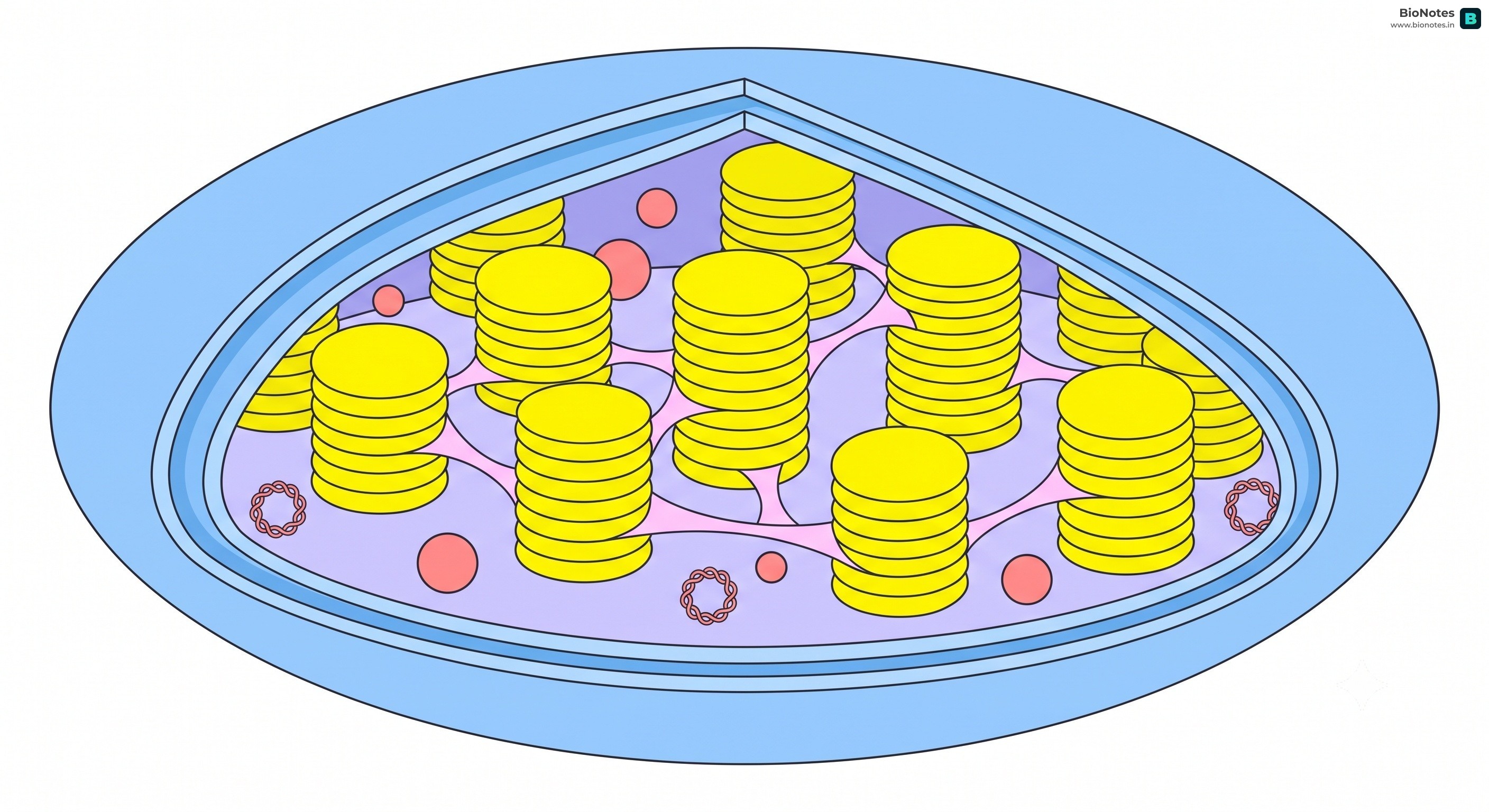
A chloroplast is a double-membraned organelle with a complex internal structure optimized for photosynthesis:
Outer Membrane: Permeable to small molecules.
Inner Membrane: Regulates the passage of materials into and out of the chloroplast.
Stroma: The fluid-filled space enclosed by the inner membrane. It contains enzymes, ribosomes, and DNA. The dark reactions (biosynthetic phase) of photosynthesis occur here.
Thylakoids: A system of interconnected flattened sacs or discs suspended within the stroma. The light reactions (photochemical phase) occur on the thylakoid membranes.
Grana (singular: Granum): Stacks of thylakoids. Each granum is like a stack of coins.
Stroma Lamellae (Intergranal Thylakoids): Unstacked thylakoids that connect adjacent grana.
Chlorophyll: The green photosynthetic pigment, along with other accessory pigments, is embedded in the thylakoid membranes.
These reactions require light energy directly and occur on the thylakoid membranes (specifically in the grana) of the chloroplast.
Activation of Chlorophyll: When light energy (photons) strikes chlorophyll 'a' molecules, it excites their valence electrons to a higher energy level, leaving the chlorophyll molecule in an activated, ionized state.
Photolysis of Water (Splitting of Water): The energy from activated chlorophyll is used to split water molecules on the inner side of the thylakoid membrane. This reaction is catalyzed by the Oxygen-Evolving Complex (OEC) and releases electrons, protons (H+), and molecular oxygen:
2H2O→4H++4e−+O2↑
Protons accumulate in the thylakoid lumen.
Electrons are used to replace the lost electrons of activated chlorophyll 'a'.
Oxygen is released as a metabolic byproduct (which is the source of all atmospheric oxygen).
Photophosphorylation (ATP Formation): The high-energy electrons are passed along an Electron Transport Chain (ETC) in the thylakoid membrane. The energy released during electron flow is used to generate a proton gradient that drives the synthesis of ATP from ADP and inorganic phosphate (Pi) via ATP synthase:
ADP+Pi⟶Light EnergyATP
Reduction of NADP⁺ to NADPH: The final electron acceptor of the photochemical chain is NADP+. It combines with the electrons and protons in the stroma to form reduced NADPH:
NADP++2H++2e−→NADPH+H+
Assimilatory Power: The ATP and NADPH generated in the light reaction represent the chemical energy (assimilatory power) that will be used to drive the dark reactions.
These reactions do not directly require light but depend on the ATP and NADPH produced during the light reactions. They occur in the stroma of the chloroplast.
Carbon Fixation (Carboxylation): Carbon dioxide (CO2) from the atmosphere combines with a 5-carbon compound, Ribulose-1,5-bisphosphate (RuBP), to form an unstable 6-carbon intermediate, which immediately splits into two 3-carbon molecules of 3-Phosphoglycerate (3-PGA). This reaction is catalyzed by the enzyme RuBisCO.
RuBP (5C)+CO2⟶RuBisCO2×3-PGA (3C)
Reduction: The 3-PGA molecules are phosphorylated by ATP and reduced by NADPH to form Glyceraldehyde-3-phosphate (G3P) or Triose Phosphate. This step utilizes the chemical energy stored during the light reactions.
Regeneration of RuBP: Most of the G3P molecules undergo a complex series of rearrangements to regenerate the primary CO2 acceptor, RuBP (requiring ATP), ensuring the continuous functioning of the cycle.
Glucose Synthesis: For every 6 molecules of CO2 fixed, 1 net molecule of glucose (C6H12O6) is produced. The glucose is subsequently converted into starch for long-term storage or sucrose for transport via phloem.
Stoichiometry: Synthesis of one molecule of glucose requires 18 ATP and 12 NADPH.
The opening and closing of stomata are driven by turgor pressure changes in the guard cells, regulated by the active transport of potassium ions:
Stomatal Opening (In Light):
Light triggers the active pumping of hydrogen ions (H+) out of the guard cells, creating an electrical gradient.
Potassium ions (K+) are actively imported into the guard cells along with malate ions.
The high concentration of K+ decreases the osmotic (water) potential inside the guard cells.
Water from surrounding accessory cells enters the guard cells via endosmosis.
The guard cells swell and become turgid. Due to their uneven wall thickness (the inner wall is thick and inelastic, while the outer wall is thin and elastic), the outer walls bulge outwards, pulling the inner walls apart and opening the stomata.
Stomatal Closing (In Dark/Water Stress):
In the absence of light or during water deficit, active transport of K+ stops.
Potassium ions (K+) passively diffuse out of the guard cells into the surrounding epidermal cells.
The osmotic potential of the guard cells increases, causing water to flow out of them via exosmosis.
The guard cells lose turgidity and become flaccid, causing the stomatal pore to close.
Chloroplasts: Abundant in photosynthetic cells, especially in the palisade layer, and can orient themselves to maximize light absorption.
Vascular Bundles (Veins): Contain xylem (for water transport) and phloem (for sugar transport), ensuring efficient delivery of water and removal of synthesized sugars.
Root System: Efficiently absorbs water and minerals necessary for photosynthesis.
Before conducting most photosynthesis experiments, plants are often destarched. This involves keeping the plant in darkness for 24-48 hours, forcing it to use up any stored starch. This ensures that any starch detected after the experiment was newly formed during the experimental period.
Steps involved in the Starch Test (Iodine Test):
Boil the leaf in water: To kill the cells and break down cell membranes, making them permeable.
Boil the leaf in alcohol (ethanol): To remove chlorophyll.
Fire Hazard!
Alcohol is highly inflammable. Never boil it directly over a flame. Always use a water bath (place the container of alcohol inside a beaker of boiling water) for safety.
This is done in a water bath to prevent the alcohol from catching fire. Removing chlorophyll allows the color change of the iodine to be clearly visible.
3. Wash the leaf in cold water: To soften the leaf and remove any remaining alcohol.
4. Add iodine solution: Place the leaf on a white tile and add a few drops of iodine solution.
Observation: If starch is present, the leaf will turn blue-black. If no starch is present, it will remain yellowish-brown (the color of iodine).
Cover a part of one leaf on both sides with a black paper or aluminum foil clip, ensuring no light reaches the covered part.
Expose the plant to sunlight for several hours.
Perform the starch test on the covered and uncovered parts of the leaf.
Observation: Only the uncovered part of the leaf will turn blue-black, indicating starch formation. The covered part will remain yellowish-brown, showing that light is necessary for photosynthesis.
Place one plant under a bell jar with a watch glass containing potassium hydroxide (KOH) solution (which absorbs CO₂).
Place the second plant under another bell jar with a watch glass containing plain water (as a control).
Seal the bell jars to make them airtight.
Expose both setups to sunlight for several hours.
Perform the starch test on a leaf from each plant.
Observation: The leaf from the plant in the bell jar with KOH will not show starch (yellowish-brown), while the leaf from the control plant will turn blue-black. This demonstrates that carbon dioxide is necessary for photosynthesis.
Take a destarched potted plant with variegated leaves (e.g., Coleus or Croton, which have green and non-green/white patches).
Expose the plant to sunlight for several hours.
Draw an outline of the leaf, marking the green and non-green areas.
Perform the starch test on the leaf.
Observation: Only the green parts of the leaf will turn blue-black, while the non-green (white) parts will remain yellowish-brown. This proves that chlorophyll is essential for photosynthesis.
This is implicitly shown by all the above experiments. If the necessary conditions (light, CO₂, chlorophyll) are met, starch is formed, as indicated by the positive iodine test (blue-black color).
Take an aquatic plant (e.g., Hydrilla or Elodea) and place it in a beaker containing pond water.
Invert a funnel over the plant and place a test tube filled with water over the stem of the funnel.
Place the entire setup in sunlight.
Observation: Bubbles will be seen rising from the plant and collecting in the inverted test tube. When a glowing splint is introduced into the test tube, it will rekindle, confirming the presence of oxygen. This demonstrates that oxygen is released during photosynthesis.
The carbon cycle is the biogeochemical cycle by which carbon is exchanged among the biosphere, pedosphere, geosphere, hydrosphere, and atmosphere of the Earth. Photosynthesis plays a central role in this cycle.
Imagine carbon moving through different reservoirs on Earth:
Atmospheric Carbon Dioxide (CO₂): Carbon exists in the atmosphere primarily as carbon dioxide gas. This is the main source of carbon for photosynthesis.
Photosynthesis (Carbon Fixation): Plants and other photosynthetic organisms absorb atmospheric CO₂. Using light energy, they convert this inorganic carbon into organic compounds (glucose, starch, cellulose, etc.). This process removes carbon from the atmosphere and incorporates it into living matter.
Consumption (Food Chains): When herbivores eat plants, the carbon compounds are transferred to their bodies. Carnivores then eat herbivores, further transferring carbon up the food chain. Thus, carbon moves through the biotic components of the ecosystem.
Respiration: All living organisms (plants, animals, microbes) perform cellular respiration. During respiration, organic carbon compounds are broken down to release energy, and CO₂ is released back into the atmosphere (or water, if aquatic respiration).
Decomposition: When plants and animals die, decomposers (bacteria and fungi) break down their organic remains. During decomposition, carbon is released as CO₂ through microbial respiration, returning it to the atmosphere and soil.
Fossil Fuel Formation: Over millions of years, under specific geological conditions (high pressure and temperature), dead organic matter that did not fully decompose can be transformed into fossil fuels (coal, oil, natural gas). This process locks carbon away in the geosphere.
Combustion: The burning of fossil fuels (for energy, transportation, industry) releases large amounts of stored carbon back into the atmosphere as CO₂. Natural combustion (e.g., forest fires) also releases CO₂.
Oceanic Carbon: Oceans act as a major carbon sink. CO₂ from the atmosphere dissolves in ocean water. Marine organisms use this dissolved carbon to build shells and skeletons (e.g., calcium carbonate). When these organisms die, their remains can form sedimentary rocks (like limestone), storing carbon for long periods. Volcanic activity also releases CO₂.
In essence, the carbon cycle is a continuous loop: Carbon moves from the atmosphere to living organisms (photosynthesis), through food chains, back to the atmosphere (respiration, decomposition, combustion), and also cycles through oceans and geological reservoirs. Photosynthesis is the crucial step that brings atmospheric carbon into the biological world, making it available for all other life forms.
 BioNotes