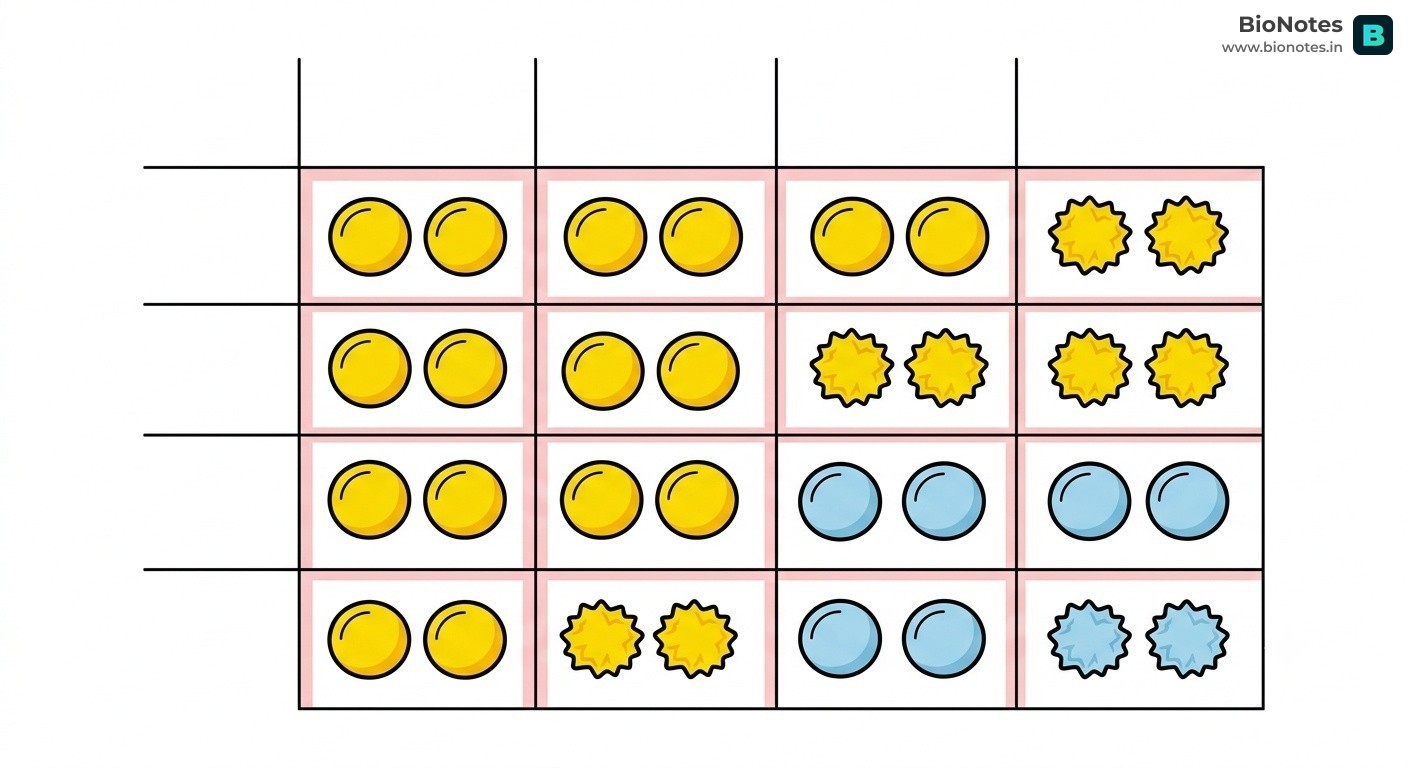
Watch Out! Genetics can be tricky. Make sure you avoid these common traps:
Misconception 1:Dominant traits are always more common in a population.Correction: Dominance only refers to how an allele behaves in a heterozygote, not how common it is. For example, having five fingers is a recessive trait, but it's the most common phenotype in humans!
Misconception 2:You inherit exactly half of your traits from your mother and half from your father.Correction: You inherit half of your genes from each parent, but how those genes interact and are expressed (your traits) is much more complex.
Genetics is the branch of biology that focuses on the study of genes, geneticvariation, and heredity in living organisms. It explores how traits are passed from parents to offspring and how they are expressed and vary within populations.
This law states that in a cross between two parents with pure, contrasting traits, only one form of the trait, the dominant one, will appear in the next generation (F1). The trait that is not expressed is called the recessive trait.
Example: When a pure-bred tall pea plant (TT) is crossed with a pure-bred dwarf pea plant (tt), all the offspring in the first generation (F1) are tall. The allele for tallness (T) is dominant over the allele for dwarfness (t).
This law states that during the formation of gametes (sperm or egg cells), the two alleles for a heritable character separate or segregate from each other, so that each gamete ends up with only one allele for that character.
Example: An F1 generation tall plant (Tt) will produce two types of gametes: half will carry the tall allele (T), and the other half will carry the dwarf allele (t).
This law states that the alleles for different traits are sorted and passed on to the offspring independently of one another. The inheritance of one trait does not affect the inheritance of another.
Example: The inheritance of seed shape (round or wrinkled) is independent of the inheritance of seed color (yellow or green).
Competitive Edge: Beyond Mendel
Not all traits follow simple dominant-recessive rules. Examiners often test these critical exceptions:
Incomplete Dominance: Neither allele is completely dominant. The heterozygous phenotype is a blend. Example: Snapdragon (Antirrhinum) or Four O'clock plant (Mirabilis jalapa). Crossing red (RR) and white (rr) flowers produces pink (Rr) flowers in F1.
Co-dominance: Both alleles are expressed equally in the heterozygote. Example: Human AB blood group (IA and IB alleles are co-dominant).
Multiple Alleles: More than two alleles exist for a single gene in a population. Example: Human ABO blood type is controlled by three alleles (IA, IB, i).
Pleiotropy: A single gene controls multiple, seemingly unrelated phenotypic traits. Example: Sickle cell anemia or Phenylketonuria (PKU).
Gene: The basic physical and functional unit of heredity. Genes are made up of DNA.
Allele: One of two or more alternative forms of a gene that arise by mutation and are found at the same place on a chromosome.
Homozygous: Having two identical alleles for a particular gene (e.g., TT or tt).
Heterozygous: Having two different alleles for a particular gene (e.g., Tt).
Dominant: An allele that is expressed phenotypically, masking the effect of the recessive allele when present.
Recessive: An allele whose phenotypic effect is masked when a dominant allele is present.
Mutation: A permanent alteration in the nucleotide sequence of the DNA of a gene.
Variation: Differences between individuals or groups of organisms of any species, often caused by genetic differences (genotypic variation) or by the effect of environmental factors.
Phenotype: The set of observable physical and biochemical characteristics of an individual, resulting from the interaction of its genotype with the environment. (e.g., tall, dwarf).
Genotype: The genetic makeup of an individual organism (e.g., TT, Tt, tt).
Syllabus History & Status (Autosomes and Allosomes):
From ICSE 2028 onwards: Mandatory (Explicit distinction between autosomes and allosomes, including human chromosomal makeup, is part of the syllabus).
Up to ICSE 2027: Optional / Reference Only (General concepts of autosomes and sex chromosomes are covered, but the specific term 'allosomes' is not tested).
Autosomes: 22 of these pairs (44 chromosomes) are autosomes, which are identical in both males and females. They control somatic traits (general body traits).
Allosomes (Sex Chromosomes): The 23rd pair (2 chromosomes) consists of the sex chromosomes (allosomes) that determine the sex of an individual.
Females have homomorphic (identical) allosomes designated as XX.
Males have heteromorphic (different) allosomes designated as XY (where Y is smaller).
The sex of a child is determined by the chromosome carried by the sperm. If a sperm with an X chromosome fertilizes the egg, the child will be a girl (XX). If a sperm with a Y chromosome fertilizes the egg, the child will be a boy (XY).
Debunking the Myth
In many cultures, mothers are wrongly blamed for the sex of the child. Biologically, the mother always contributes an X chromosome; it is the father's sperm (X or Y) that determines the child's sex.
Sex-linked inheritance refers to traits that are inherited through the X or Y chromosomes. Most sex-linked traits are X-linked, meaning the gene responsible is located on the X chromosome.
Since males have only one X chromosome, they are more likely to be affected by X-linked recessive disorders. Females, with two X chromosomes, can be carriers of the disease without being affected themselves.
Description: A rare genetic disorder in which the blood does not clot properly due to a lack of sufficient blood-clotting proteins (clotting factors).
Inheritance: It is an X-linked recessive disorder. A son born to a carrier mother has a 50% chance of inheriting the faulty gene and having haemophilia.
Description: The inability or decreased ability to see color or perceive color differences under normal lighting conditions. The most common form is red-green color blindness.
Inheritance: It is also an X-linked recessive disorder. Like haemophilia, it is much more common in males than in females.
 BioNotes