(i) (c) Secretion of testosterone (Leydig cells secrete testosterone)
(ii) (a) Both Assertion and Reason are true, and Reason is the correct explanation for Assertion.
(iii) (b) 20 (200 ÷ 10 = 20 turns)
(iv) (c) They are exonucleases that remove nucleotides from the ends of DNA. (Restriction enzymes are endonucleases that cut within the DNA.)
(v) (c) brood parasitism
(vi) (a) Both Assertion and Reason are true, and Reason is the correct explanation for Assertion.
(vii) (a) Both Assertion and Reason are true, and Reason is the correct explanation for Assertion.
(viii) Malignant tumour [½]; metastasis [½].
(ix) 'Eco' stands for the organism Escherichia coli[½]; 'R' stands for the strain (RY13) [½].
(x) Vaccination introduces weakened/killed pathogens or their antigens, which stimulate the immune system to produce antibodies and memory B and T cells; on subsequent exposure to the real pathogen, a quicker and stronger (secondary) response occurs.
(xi) Because energy is lost as heat at each trophic level (respiration/metabolism), so the energy available at each successive level is always less than the level below it.
(xii) Final population = 400 + (60 + 10) − (20 + 30) = 420.
(xiii) Non-coding (intervening) sequence, removed during splicing.
(xiv) 5′–AGC–3′ (anticodon is antiparallel and complementary: 3′–CGA–5′).
(xvii) Towards the anode (positive electrode) [½], because DNA is negatively charged due to its phosphate groups [½].
(xviii) (a) Banana is parthenocarpic — the ovary develops into a fruit without fertilisation, so no seeds are formed [1].
(b) The fungal hyphae absorb phosphorus and water from the soil and pass them to the plant, while the plant provides carbohydrates to the fungus [1].
Before industrialisation, white-winged (light) moths were camouflaged against lichen-covered tree trunks, while dark moths were easily seen and eaten by predators [1]. After industrial soot darkened the trunks, dark moths were better camouflaged and survived in greater numbers, while light moths were eaten; thus the frequency of the dark form increased by natural selection [1].
(any two, 1 mark each) The code is triplet; it is degenerate (an amino acid is coded by more than one codon); it is unambiguous/specific (one codon codes for one amino acid); it is universal; it is non-overlapping and comma-less; AUG is the start codon and UAA, UAG, UGA are stop codons.
A nematode-specific gene is introduced into the tobacco host using Agrobacterium vectors [½]. The host cells produce sense and antisense RNA, which form double-stranded RNA (dsRNA) [½]. This dsRNA silences (degrades) the specific mRNA of the nematode, so the parasite cannot survive in the transgenic host [1].
(i) Cleistogamy: flowers that never open and in which pollination and fertilisation occur within the closed flower [1]. Advantage: assured seed set even in the absence of pollinators [1].
OR
(ii) Apomixis: the production of seeds without fertilisation [1]. Significance: hybrid seeds can be maintained generation after generation without segregation, so farmers need not buy fresh hybrid seeds every year and hybrid vigour is retained [1].
A biodiversity hotspot is a region with very high species richness and a high degree of endemism that is also under threat of severe habitat loss [1]. Examples in India: Western Ghats (and Sri Lanka), Himalaya, Indo-Burma [1] (any two).
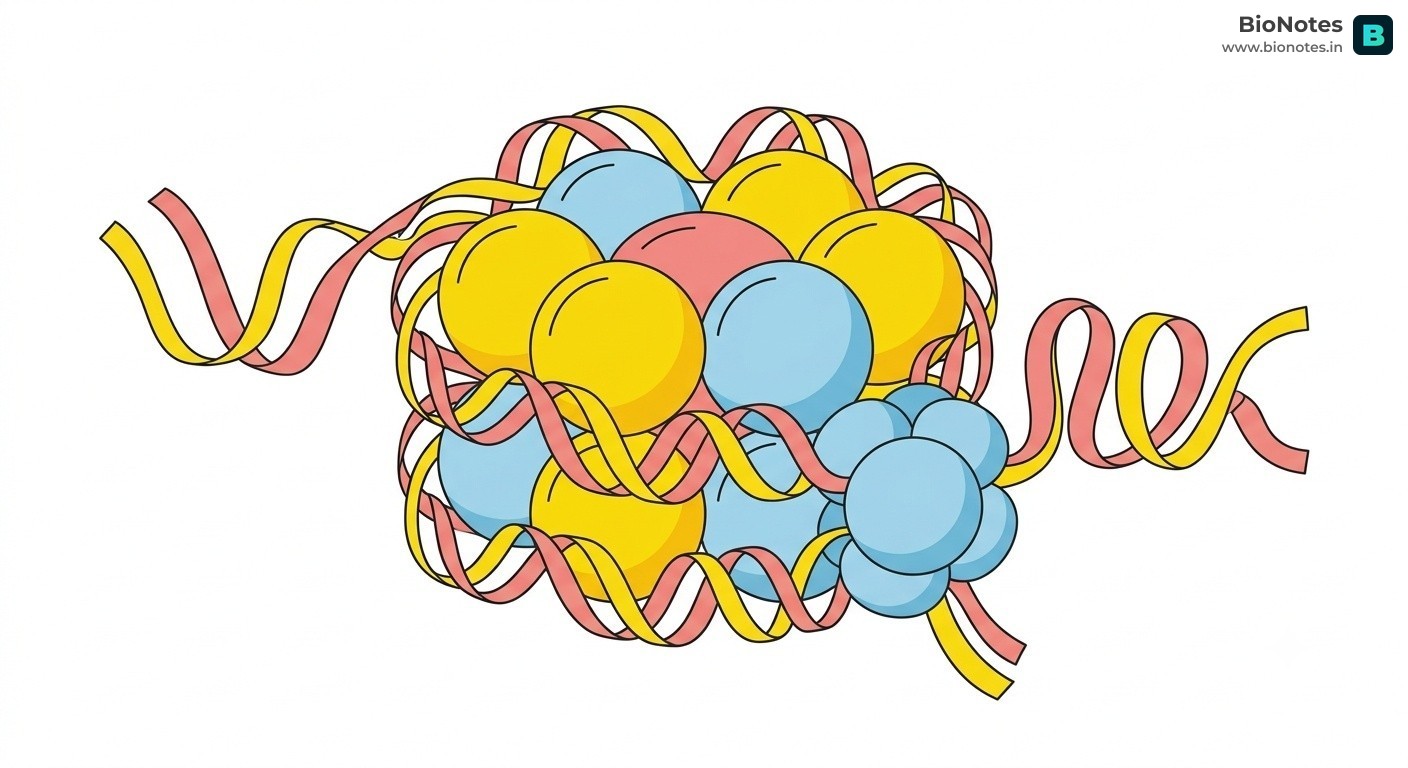
(i) A nucleosome is the basic repeating unit of chromatin, in which about 200 bp of DNA is wrapped (146 bp around the core) around a histone octamer [1]. (ii) Histones H2A, H2B, H3 and H4 (two molecules of each) [1]. (iii) H1 binds to the linker DNA at the entry/exit point of the nucleosome, helping to compact the chromatin fibre further [1].
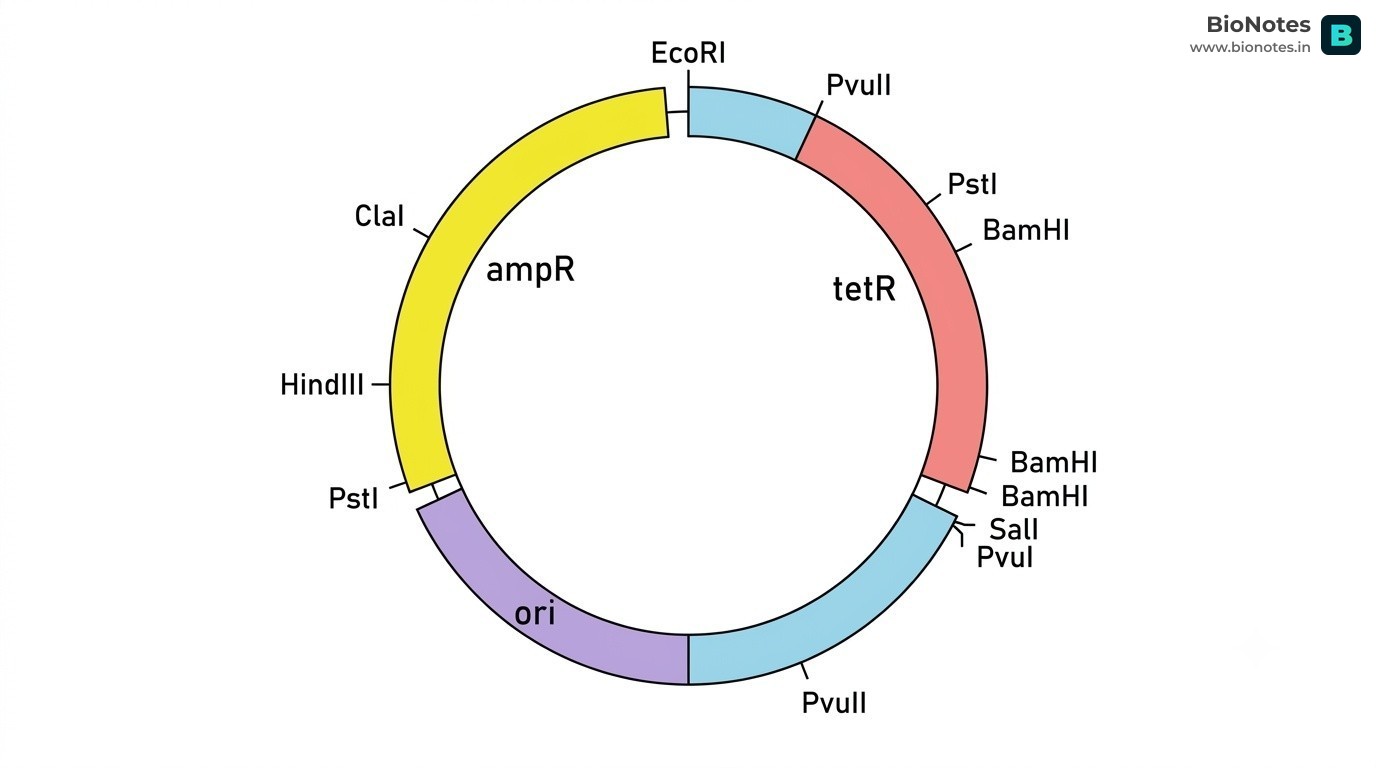
(i) Ampicillin resistance gene (ampR) and tetracycline resistance gene (tetR) [1]. (ii)ori is the origin of replication — it is the site from which replication starts and which controls the copy number of the plasmid [1]. (iii)BamHI or SalI (either one) [1].
(i) The cry genes (e.g. cryIAc, cryIAb), which code for the Cry protein (δ-endotoxin) [1]. (ii) The Cry protein is ingested as an inactive protoxin; in the alkaline pH of the insect's midgut it is solubilised and activated. The active toxin binds to the midgut epithelial cells and creates pores, causing cell swelling and lysis, leading to the death of the insect [1]. (iii) In the bacterium the toxin exists as an inactive protoxin in crystal form, so it does not harm the bacterium [1].
(i) To identify all the genes (about 20,000–25,000) in human DNA and to determine the sequence of the roughly 3 billion base pairs, and to store this information in databases [1]. (ii) Expressed Sequence Tags (ESTs) and sequence annotation [1]. (iii)(any one) Diagnosis of genetic disorders; development of gene therapy; DNA fingerprinting; understanding evolutionary relationships; development of new drugs [1].
(i) S = species richness; A = area; Z = slope of the line (regression coefficient); C = Y-intercept [2](½ mark each). (ii) Z lies in the range 0.1 to 0.2 for smaller areas, irrespective of the taxonomic group or region; for very large areas such as entire continents the slope is much steeper, with Z in the range 0.6 to 1.2[1].
(b) I-2: X^A X^a (carrier) [1]; II-2: X^A X^a (carrier; she has an affected son and received X^a from her mother) [1].
(c) II-2 (X^A X^a) × normal man (X^A Y): half of the sons are X^a Y. Probability that a son is affected = ½ (50%)[1].
(d) Individual II-1 is affected although both of his parents are unaffected. A dominant trait must be expressed in at least one parent, so the disease cannot be autosomal dominant [1].
(Also accept: the disease is seen only in males, which supports X-linked inheritance.)
Begins during the foetal life (completed after fertilisation)
One primary spermatocyte forms four functional sperm
One primary oocyte forms one functional ovum and polar bodies
Continues throughout adult life
Ceases at menopause
Controlled by FSH, LH (ICSH) and testosterone
Controlled by FSH, LH and oestrogen
(b) (i) Spermiogenesis is the transformation of spermatids into spermatozoa (sperm) [1].
(ii) Spermiation is the release of mature sperm from the Sertoli cells into the lumen of the seminiferous tubules [1].
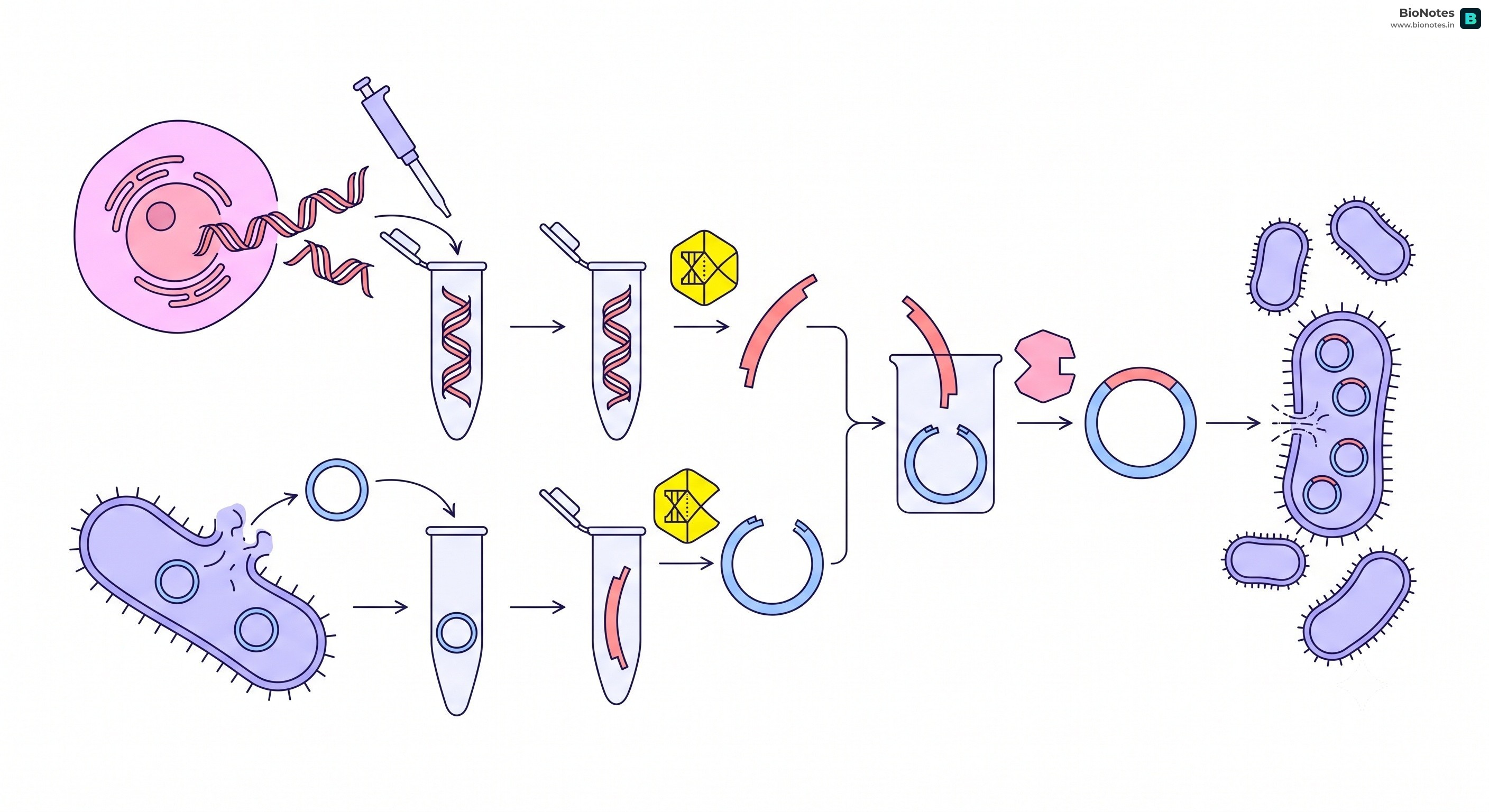
Isolation of DNA [½]: The cells are lysed using enzymes (lysozyme, cellulase, chitinase) and the genomic DNA is purified; the gene of interest is isolated (e.g. by electrophoresis).
Cutting [1]: The vector (e.g. plasmid) and the foreign DNA are cut with the same restriction endonuclease (e.g. EcoRI), producing complementary sticky ends.
Ligation [1]: The gene of interest is joined to the cut vector using DNA ligase, forming recombinant DNA (rDNA).
Transfer into host [1]: The rDNA is introduced into a competent host cell by heat shock, microinjection, gene gun or Agrobacterium.
Selection by insertional inactivation [1½]: When the gene is inserted into the BamHI/SalI site of the tetR gene of pBR322, the tetracycline-resistance gene is inactivated. Transformants are grown on ampicillin-containing medium; the colonies that survive on ampicillin but fail to grow on tetracycline medium contain recombinant plasmids, while non-recombinants grow on both.
OR
(ii) Energy flow in an ecosystem:
Source and PAR [1]: The sun is the source of energy. Photosynthetically Active Radiation (PAR) is about 50% of the incident solar radiation, and only about 2–10% of PAR is captured by plants (producers) and converted into chemical energy.
Unidirectional flow [1]: Energy flows from producers to consumers and decomposers in one direction only; it is not recycled.
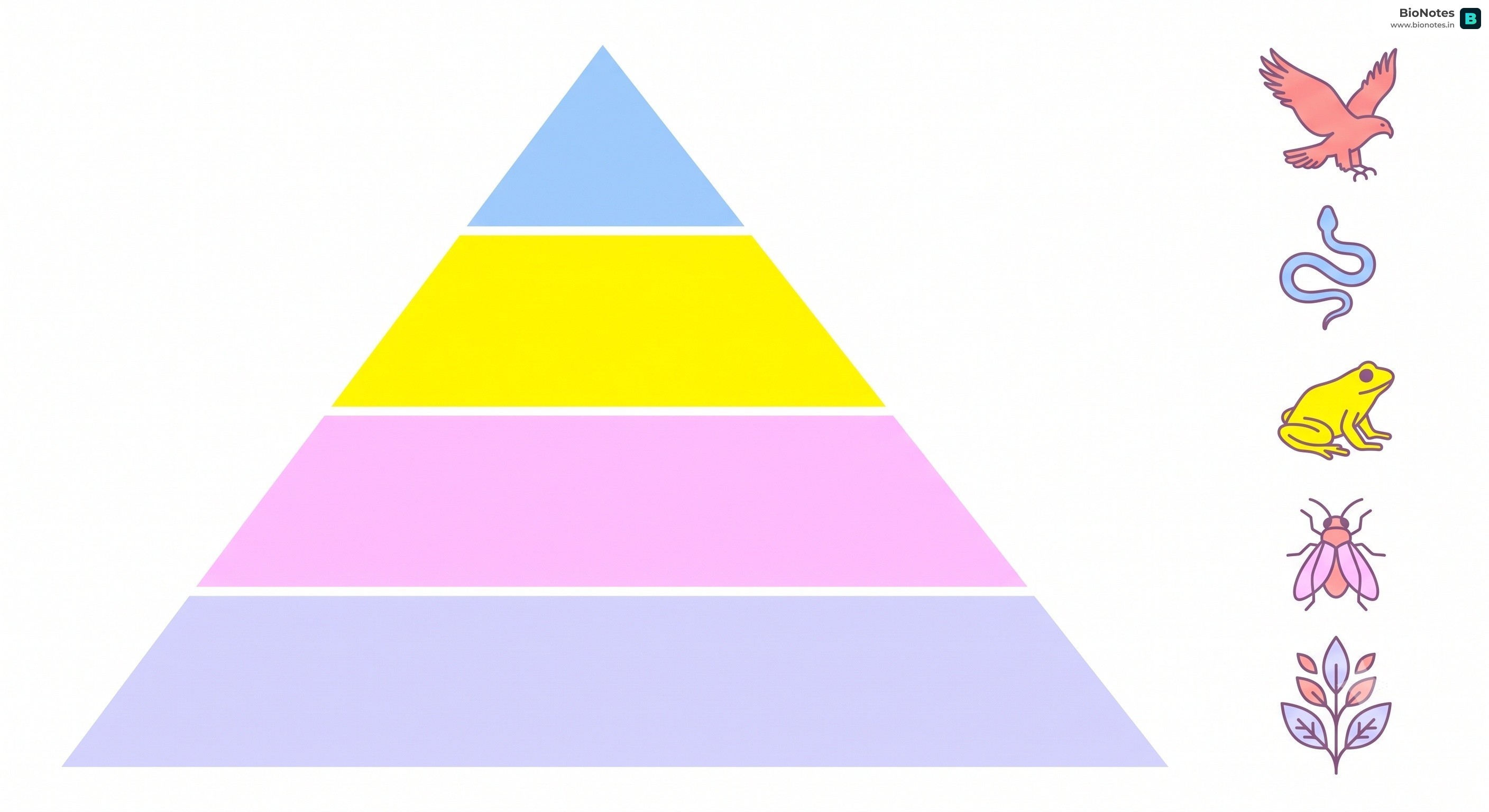
Grazing food chain and 10% law [2]: In a grazing food chain (Grass → Grasshopper → Frog → Snake) only about 10% of the energy at one trophic level is transferred to the next (Lindeman's 10% law); the rest is lost as heat in respiration and in other metabolic activities. Example: 1000 J (producer) → 100 J → 10 J → 1 J.
Upright pyramid of energy [1]: Because energy is lost at every transfer, the energy available at each successive trophic level decreases. Hence the base (producers) always has the maximum energy and the pyramid of energy is always upright.
Interactive Diagram•study Mode
||
www.bionotes.in
Diagrams in the marking scheme are from the BioNotes diagram bank. Question–answer design by the BioNotes teaching team; syllabus alignment: CISCE ISC 2027 Biology (863) Class XII.