Class 9
Created by Titas Mallick
Biology Teacher • M.Sc. Botany • B.Ed. • CTET (CBSE) • CISCE Examiner
 BioNotes
Created by Titas Mallick
Biology Teacher • M.Sc. Botany • B.Ed. • CTET (CBSE) • CISCE Examiner
Online
Common Misconceptions
Watch Out! Seeds are essentially packaged, dormant baby plants:
A seed is the final product of sexual reproduction in plants. It is essentially a baby plant (the embryo) in a dormant state, packed with a food supply and protected by an outer coat. When conditions are right, this dormant embryo awakens and grows into a new plant, a process called germination.
Seeds are broadly classified into two groups based on the number of cotyledons (seed leaves) they possess: dicotyledonous (dicot) seeds and monocotyledonous (monocot) seeds.
A bean seed is a typical non-endospermic (exalbuminous) dicot seed, meaning the food is stored in the large cotyledons, and the endosperm is absent in the mature seed.
The Micropyle's Dual Role The micropyle serves two main functions:
A maize grain is a type of fruit called a caryopsis, where the fruit wall (pericarp) is fused with the seed coat (testa). It is an endospermic (albuminous) seed, meaning it has a special food-storing tissue called the endosperm.
| Feature | Dicot Seed (Bean) | Monocot Seed (Maize) |
|---|---|---|
| Cotyledons | Two cotyledons. | One cotyledon (scutellum). |
| Endosperm | Absent in mature seed (non-endospermic / exalbuminous). | Present in mature seed (endospermic / albuminous). |
| Food Storage | Food is stored in the cotyledons. | Food is stored in the endosperm. |
| Embryo Size | Embryo is large. | Embryo is small. |
| Protective Sheaths | Coleoptile and coleorhiza are absent. | Plumule is protected by coleoptile; radicle by coleorhiza. |
 www.bionotes.in
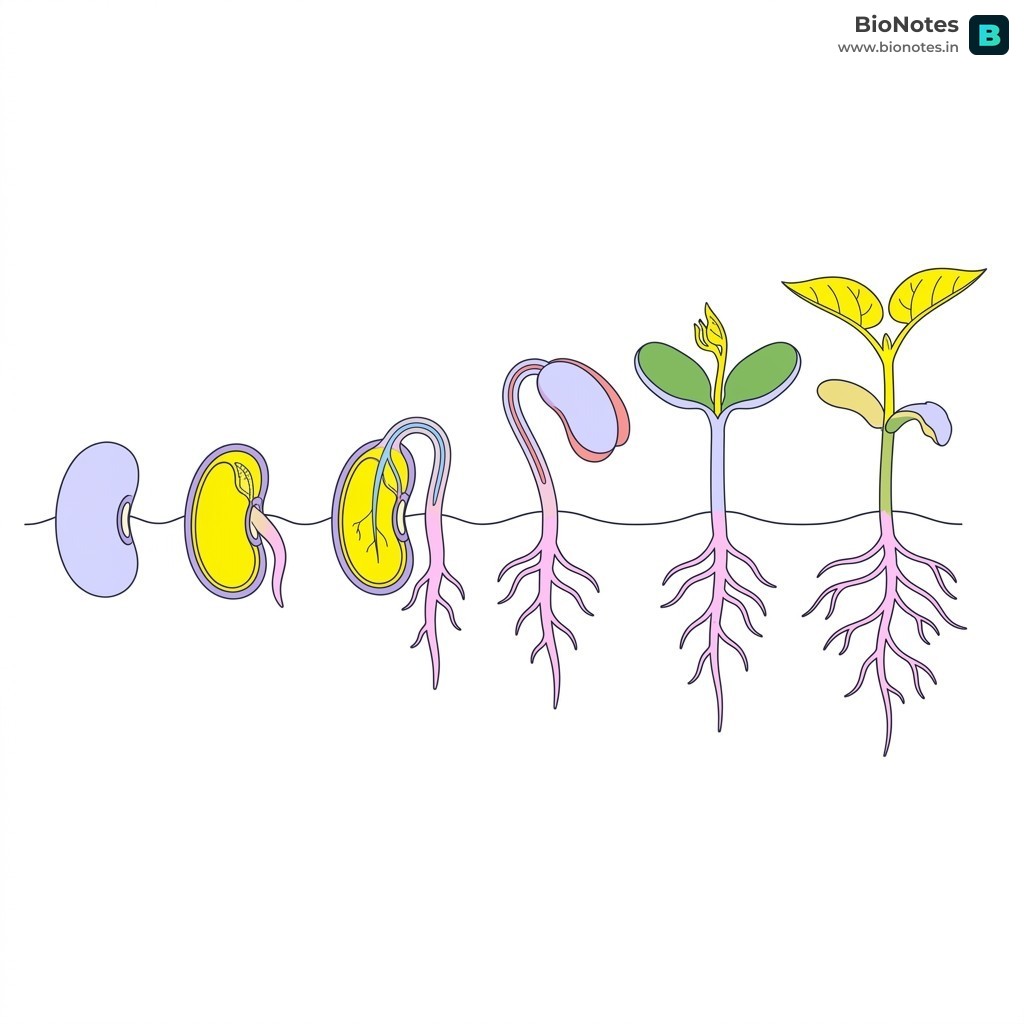
Germination is the process by which the dormant embryo within a seed resumes its growth and develops into a seedling, which can grow independently.
Epigeal Germination (e.g., Bean Seed):
Hypogeal Germination (e.g., Maize Grain, Pea Seed):
| Feature | Epigeal Germination (Bean) | Hypogeal Germination (Maize/Pea) |
|---|---|---|
| Fate of Cotyledons | Pushed above the soil. | Remain below the soil. |
| Function of Cotyledons | May become the first photosynthetic leaves. | Solely provide nutrition; never photosynthesize. |
| Elongating Part | The hypocotyl elongates and pushes the cotyledons up. | The epicotyl elongates, leaving the cotyledons behind. |
For a seed to germinate, it needs a combination of favorable external conditions. These can be demonstrated by simple experiments.
Water (Moisture):
Oxygen (Air):
Suitable Temperature (Warmth):
NGSS-MS-LS1-5AQA-GCSE-4.4.1KS3-Biology