Complete practical guide for ISC Class XII Biology - floral taxonomy for seven families, DNA isolation, enzyme action, stomata, soil study, slide preparation, spotting, project and practical file, with the recent examination pattern
The practical was held in batches, so specimens differ between batches. The structure of the 3-hour paper (plus 15 minutes of reading time) was:
Question
Content
Marks
Q1
Flower dissection, isolate the pistil, floral formula, family, two features of androecium/gynoecium, botanical name of an economic plant
5
Q2
DNA isolation from a fruit pulp, with six questions on the result and the method
3
Q3
Free-hand section of an ovary, labelled diagram, type of placentation with one reason
2
Q4
Five spots (3 minutes each), answered on a separate sheet handed in immediately
5
Q5
Project presentation (10) and practical file (5) assessed by the Visiting Examiner
15
Common Misconceptions
Misconception 1:The floral formula and the floral diagram are the same.Correction: The formula is written in symbols; the diagram is a cross-section plan showing the whorls in circles, with the mother axis drawn correctly.
Misconception 2:DNA appears as a clear liquid in the ethanol layer.Correction: DNA appears as white, thread-like (fibrous) strands where the alcohol layer meets the extract, because DNA is insoluble in cold ethanol.
Zygomorphic, papilionaceous corolla (standard, two wings, two keel petals); stamens diadelphous (9)+1; ovary superior, monocarpellary, unilocular, marginal placentation; fruit a legume
Ray floret: % ♀ K pappus C(3) G̅(2). Disc floret: ⊕ ⚥ K pappus C(5) A(5) G̅(2)
Inflorescence a capitulum; stamens syngenesious (anthers fused), epipetalous; ovary inferior, bicarpellary, unilocular, basal placentation with a single ovule; fruit a cypsela
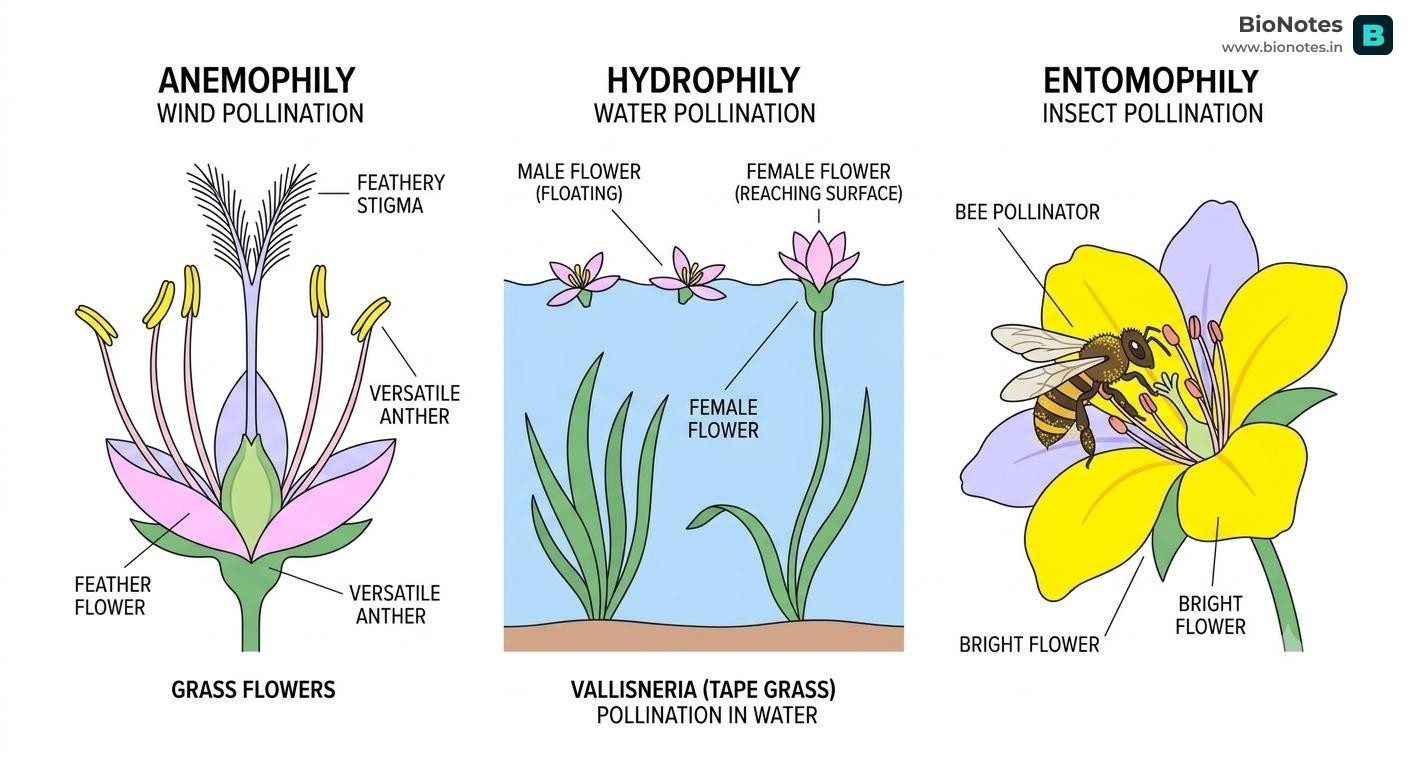
Flower enclosed by lemma and palea, reduced perianth of two lodicules; stamens usually 3 with versatile anthers; ovary superior, unilocular, single ovule, basal placentation; feathery stigma; fruit a caryopsis
Common names must be supported with the correct scientific name, with the genus capitalised and the species in lower case, both italicised (or underlined in handwriting): e.g., Gossypium hirsutum.
Draw a small circle (the mother axis) at the top and the bract (a small crescent) at the bottom, opposite to it.
Draw the whorls as concentric arcs or circles from the outside in: bracteoles/epicalyx, calyx, corolla, androecium, gynoecium at the centre.
Show fusion by joining the lines, aestivation (valvate, twisted, imbricate, vexillary) by overlapping edges, and adhesion (epipetalous) by connecting the stamens to the petals.
Draw the ovary as a cross-section showing the number of locules and the placentation.
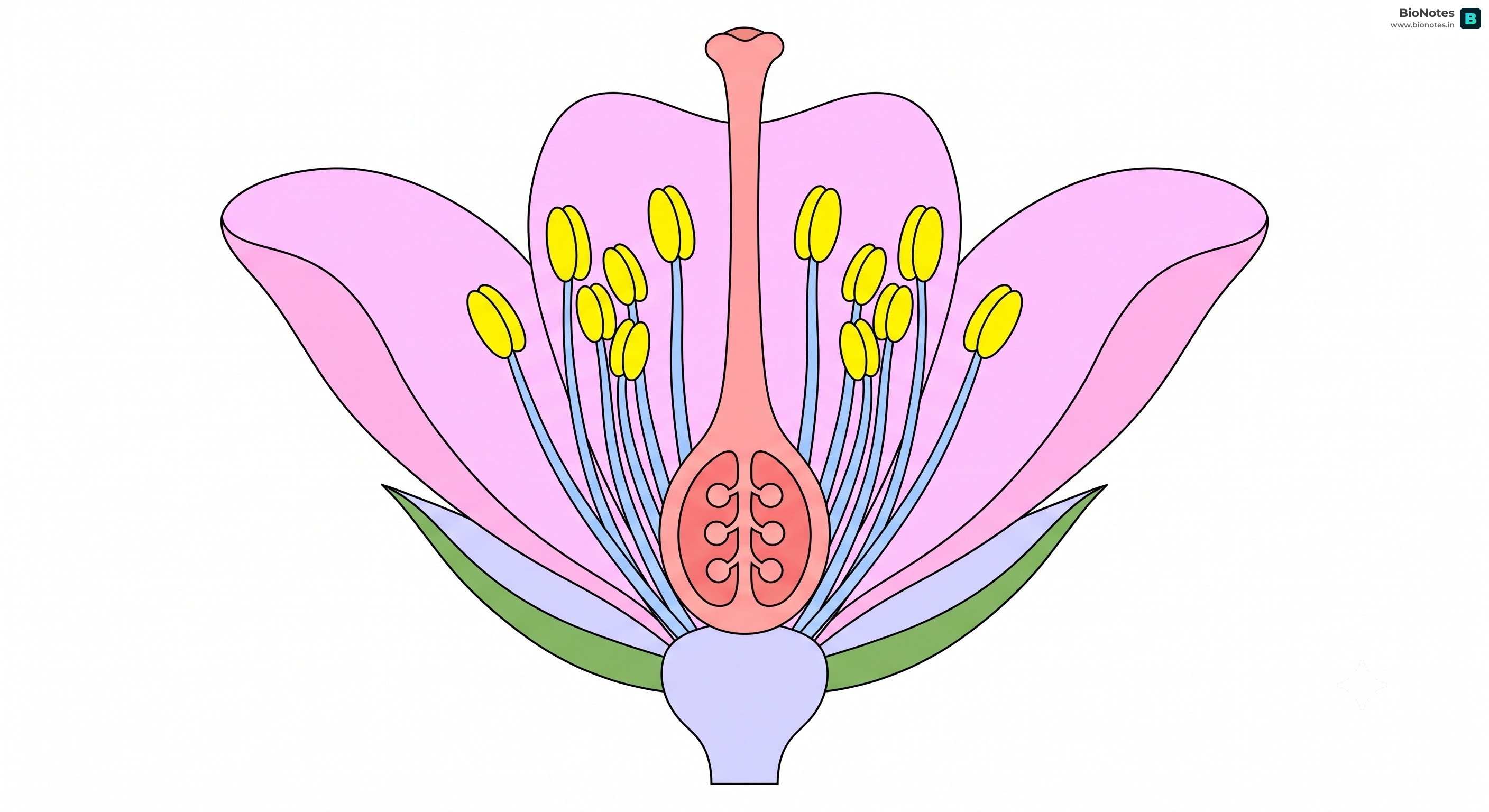
(a) Pistil: Remove the epicalyx, sepals, petals and staminal tube; place the pistil (ovary, style and five stigmas) in a Petri dish and show it to the Visiting Examiner.
Androecium: stamens are monadelphous; the filaments are fused into a tube around the style.
Gynoecium: ovary is superior, pentacarpellary and syncarpous.
(e) Economic plant:Gossypium hirsutum (cotton), a source of fibre.
A note on the formula
The official scheme for this paper began the formula with "Epi5", while many textbooks put the epicalyx just before the calyx (as above). What matters is that every symbol is present and correct: bract and bracteoles, actinomorphic, bisexual, epicalyx, five fused sepals, five petals, many stamens, five fused carpels, and the superior ovary.
Sources: Spinach leaves, green pea seeds, banana or papaya pulp.
Extraction fluid: 1.5 g table salt + 10 ml liquid detergent + 90 ml distilled water.
Syllabus protocol: Mash a ripe peeled banana (half) into a pulp; add 50 ml of extraction fluid; keep in a water bath at 60 °C for 15 minutes with gentle stirring; filter 5 ml of the cooled content into a test tube; slowly add 5 ml of cold 90% ethanol along the wall.
Follow the paper, not your memory
In the 2026 paper the question text gave slightly different quantities and temperature: 10 ml of pulp, 50 ml of extraction fluid, a water bath at 70 °C for 15 minutes, 10 ml of cooled filtrate and slowly pouring 90% chilled ethanol. Always carry out the procedure exactly as written in the question paper, because the instructions may differ from the textbook protocol.
Observation: White, thread-like, cloudy strands of DNA appear at the interface where the ethanol floats above the extract.
Question asked
Model answer
Role of detergent
Breaks down (dissolves) the lipid bilayer of the cell and nuclear membranes, releasing DNA
Role of salt
Neutralises the negative charge on DNA, so strands clump together and precipitate
Role of heating
Speeds up lysis and denatures enzymes that would degrade DNA (not so hot that the DNA is damaged)
Role of chilled ethanol
DNA is insoluble in cold alcohol, so it precipitates out of the solution
Major contaminant
Proteins (also lipids and cell debris)
Constituent units of the structure
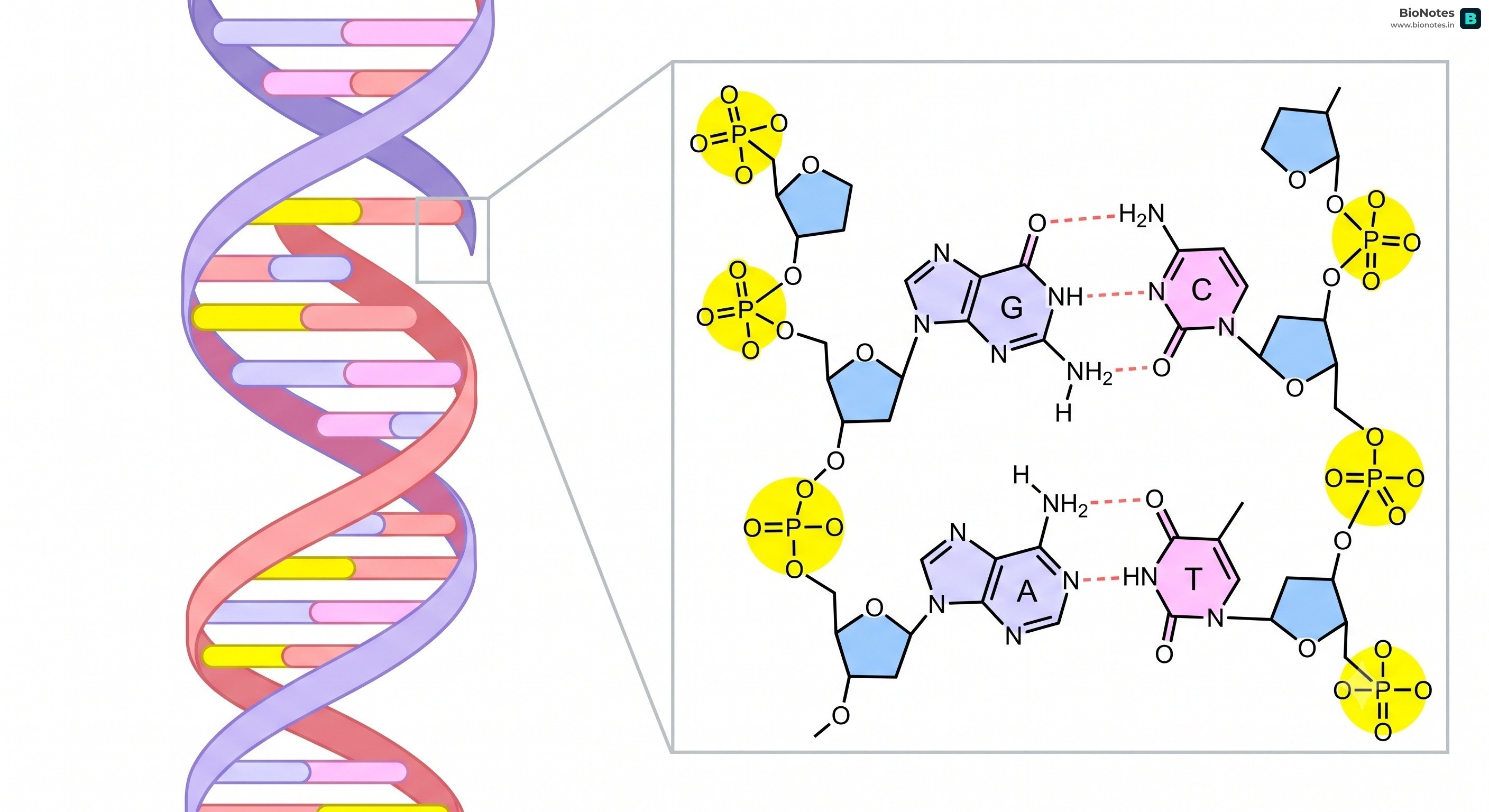
Nucleotides; each has deoxyribose sugar, a phosphate group, and one nitrogenous base (adenine, guanine, cytosine or thymine)
Why this answer for the last row?
The marking scheme from the 2026 session listed just the four bases (A, G, C, T). The biologically complete answer is nucleotides, made of sugar, phosphate and a base. Writing "nucleotides, each with a deoxyribose sugar, a phosphate and one of the bases A, G, C or T" covers both.
Aim: To study the effect of amylase (or diastase) on starch at three temperatures and three pH values.
Set-up: Tubes of starch solution with the enzyme at: below 10 °C (ice bath), 37 °C (optimum), above 70 °C; and at acidic, neutral and basic pH (using a drop of dilute HCl, water or dilute NaOH, or buffers).
Procedure: At regular intervals (every 30 seconds to 1 minute), take a drop from each tube and mix with a drop of iodine on a white tile. Note the time taken for the blue-black colour to disappear.
Observation and inference:
At 37 °C and neutral pH, starch disappears fastest: the enzyme works best at its optimum.
At low temperature, activity is very slow (enzymes are inactive, not destroyed).
At high temperature (above 70 °C), the enzyme is denatured and the blue colour stays.
In acidic or basic medium, activity is reduced because pH alters the shape of the active site.
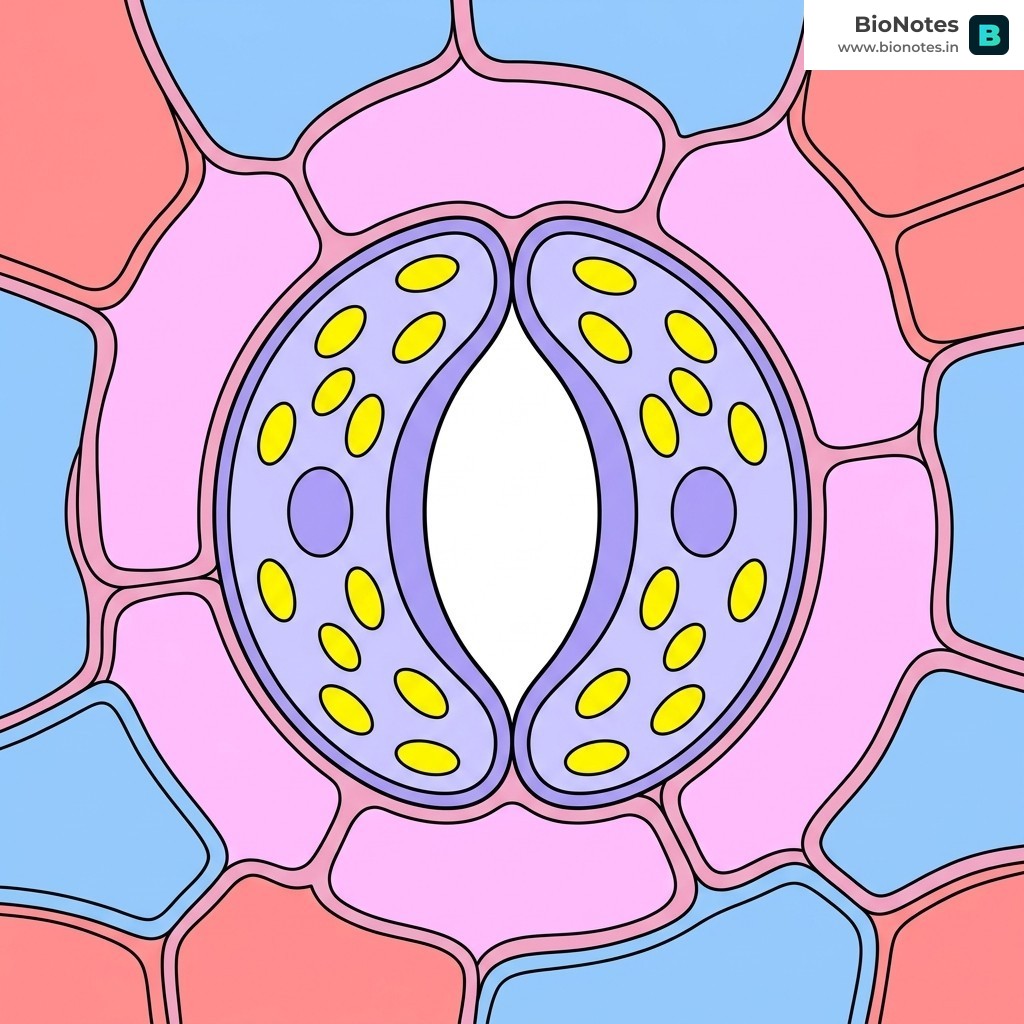
Method: Peel a thin piece of the upper and lower epidermis (or take a clear nail-polish impression), mount in water or stain with safranin, and count the stomata in one microscope field for each surface.
Collect samples from two sites (for example, a garden and a roadside; a dry place and a wet place).
Property
Method
Expected result
Texture
Rub between fingers; note gritty (sandy), sticky (clayey) or smooth (loamy)
Loamy soil is best for crops
Moisture content
Weigh fresh soil, dry in an oven or in the sun, reweigh. Moisture % = (loss in weight ÷ fresh weight) × 100
Higher in wet-place soil
Humus content
Compare colour (dark = more humus) or measure loss of weight on burning
Higher in garden or cultivated soil
Water holding capacity
Pour a known volume of water onto a known weight of soil in a funnel; measure the volume of water drained. Water retained = water added - water collected
Higher in clayey and humus-rich soil
pH
Shake soil with distilled water, filter, test the filtrate with pH paper
Prepare a medium of about 10% sucrose with a trace of boric acid in a cavity slide, dust fresh pollen (e.g., from Hibiscus, Impatiens, pea) into a drop, keep in a humid chamber for 30-60 minutes, and observe.
Observation: Pollen grains put out a pollen tube through the germ pore. In a good preparation the tube nucleus and two male gametes are visible near the tip.
Two identifying features: Large air cavities (aerenchyma) in the cortex and poorly developed xylem (reduced vascular tissue and mechanical tissue). Cuticle is thin or absent.
Cortex with follicles at various stages, stroma in the centre; Graafian follicle with an antrum and an oocyte surrounded by zona pellucida; corpus luteum
Section of mammalian testis (T.S. or L.S. as given)
Many seminiferous tubules lined with spermatogenic cells and Sertoli cells; interstitial (Leydig) cells between tubules
Germinating pollen grain
Pollen tube emerging from the germ pore; tube nucleus and generative cell or male gametes; double-layered wall (exine and intine)
T.S. of ovary (placentation)
Identify as marginal, axile, basal or parietal using the number of locules and the position of ovules
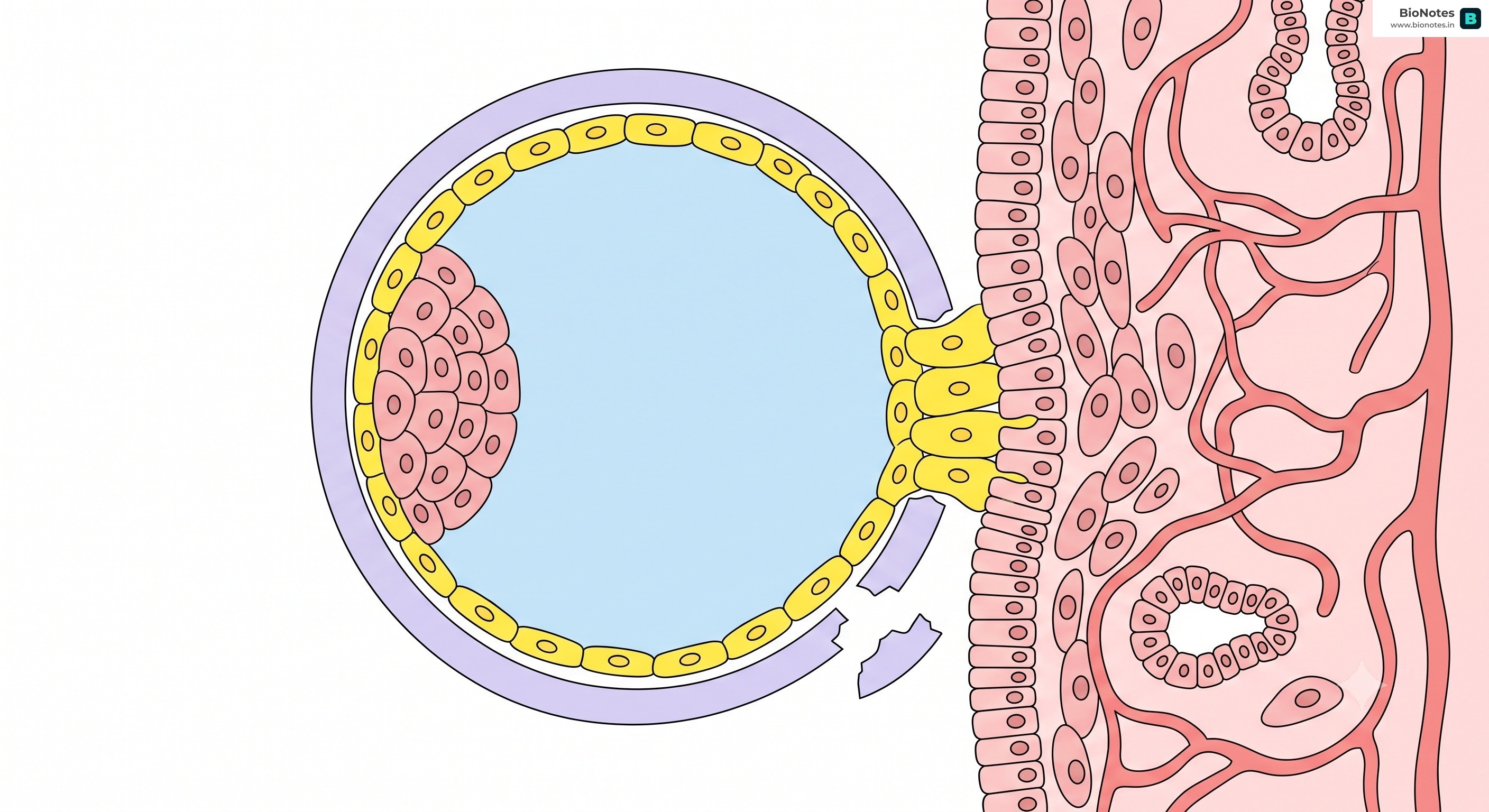
T.S. of blastula or blastocyst of a mammal
Hollow ball; outer layer of trophoblast cells; inner cell mass clustered on one side; fluid-filled blastocoel
Whole mount of Plasmodium sporozoite
Slender, sickle- or spindle-shaped, pointed at both ends, with a central nucleus
Whole mount of Entamoeba histolytica trophozoite
Irregular shape with blunt pseudopodia; single nucleus with a small central karyosome and a ring of chromatin; may contain ingested red blood cells; no contractile vacuole
Preserved Ascaris
Long, cylindrical, unsegmented, tapering at both ends; female larger and straight, male smaller with a curved posterior end (penial spicules)
Leaves reduced or modified into spines to cut water loss; thick, fleshy, green stem stores water and carries out photosynthesis; thick cuticle, sunken stomata
Hydrilla (submerged hydrophyte)
Thin, narrow leaves with thin cuticle; air spaces (aerenchyma) give buoyancy; reduced root system
Bony fish (aquatic animal)
Streamlined body to reduce water resistance; gills with operculum for respiration; fins for swimming; lateral line for sensing water movement
Camel (desert animal)
Fat stored in the hump; broad padded feet; long eyelashes and closable nostrils against sand; concentrated urine
The Visiting Examiner (appointed locally and approved by CISCE) assesses the project through a presentation.
Choose one topic: genetic disorders, gene therapy, Human Genome Project, DNA fingerprinting, bio-piracy, cancer, AIDS/Hepatitis, drug addiction, role of microorganisms in industry, human population, Mendelian inheritance, environmental resistance, traditional vs modern pest control, role of agrochemicals, or another topic of your choice.
Handwritten, original investigatory work is preferred; no plagiarism. A computer-generated project must be submitted as a signed hard copy.
Preparing for the presentation: Be ready to explain your aim, method, findings and sources in 3-5 minutes and answer follow-up questions on your own project.
Copying a sample word for word. When many files carry identical text, it is obvious. Write your own four to six lines.
Thanking everyone and no one. Name the people who actually helped (subject teacher, Head of the Institution, parents, anyone you interviewed or who gave lab access), with designations.
Missing signature and date, or placing the acknowledgement after the introduction. It goes before the contents page.
Bibliography
Writing only "Google", "YouTube", "Internet" or "Wikipedia". These are not sources. Name the author or organisation, title and page.
A web address with no page title, organisation or date accessed.
Listing books you never opened, or mixing three different styles in one list.
Not arranging entries alphabetically by the author's surname (or organisation name).
Pasting paragraphs or diagrams from a source without credit. The syllabus states that plagiarism is not allowed, and you must be able to explain every line in your viva.
If you used an AI tool to understand a topic, follow your school's rules and say so honestly. It is not an authority to cite: confirm every fact in a textbook or a reliable organisation's website first.
Sample acknowledgement (rewrite in your own words; replace everything in square brackets)
I would like to express my sincere gratitude to my Biology teacher, [Teacher's Name], for guiding me throughout this project and for checking my work at every stage. I am thankful to [Name], Head of the Institution, for the facilities provided in the laboratory. I also thank [Name of any person interviewed or who helped with data collection] for their time and information. Finally, I thank my parents for their constant support.
[Student's Name]
Class XII, Section [ ]
Date: [ ]
Format to follow for each type of source
Source
Order of details
Book
Author(s). Title. Edition. Publisher, Year.
Journal article
Author(s). "Title of article." Journal, Volume, Pages, Year.
Website
Organisation or author. "Page title." Web address. Date accessed.
Newspaper cutting
Newspaper name. "Headline." Date, page number.
Interview or survey
Name, designation, place, date of interview.
Sample bibliography (arranged alphabetically; list only what you actually used)
Jeffreys, A. J., Wilson, V. and Thein, S. L. "Hypervariable 'minisatellite' regions in human DNA." Nature, 314, 67-73, 1985. (example for a DNA fingerprinting project)
National Council of Educational Research and Training. Biology: Textbook for Class XII. New Delhi: NCERT, [year of the edition you used].
Urry, L. A., Cain, M. L., Wasserman, S. A., Minorsky, P. V. and Reece, J. B. Campbell Biology. 11th ed. Pearson, 2017. (use the edition you actually read)
World Health Organization. "[Title of the page you read]." [full web address of that page]. Accessed [date].
[Newspaper name]. "[Headline]." [Date], page [ ].
The entries above are models of format. Replace them with the books, articles and pages you really consulted, and give the year and edition exactly as printed in your copy.
All practical exercises in the syllabus, recorded date-wise, checked, signed and dated by the teacher.
Include the taxonomy exercises (all seven families with floral diagrams and formulas), DNA isolation, enzyme action, stomata, soil study, slide preparations and spotting drawings.
Read the whole paper. Do not write. Decide the order
Q1 (about 40 minutes)
Dissect, draw, write formula and family first; leave the examiner-demonstration parts early so the examiner can check them
Q2 (about 40 minutes)
Set up DNA extraction first (heating and filtering take time); answer written questions while waiting
Q3 (about 30 minutes)
Cut the sections in a series; mount the best one; draw
Q4 (15 minutes)
Five spots at 3 minutes each; hand over the sheet immediately
Final 10 minutes
Check labels, scientific names (italics or underline), and that all items were shown to the examiner
Frequent mistakes to avoid: writing the botanical name in lower case or without the species; leaving out the epicalyx in Malvaceae; confusing axile and marginal placentation; forgetting to label the mother axis in a floral diagram; pouring ethanol too fast so that the layers mix.
The staminal tube in a China rose flower is an example of:
Which type of placentation is seen in the unilocular, monocarpellary ovary of Clitoria?
In the DNA isolation experiment, chilled ethanol is added to:
Which feature supports a flower being wind-pollinated?
In a T.S. of a mammalian blastocyst, the outer layer of cells is the: